The Future of CRE Sustainability
Welcome to The Future of CRE Sustainability, where innovation meets the built environment. In each episode, our host, Sean Swentek, VP of Marketing at Omnidian, speaks with industry leaders and pioneering professionals in the CRE sector. Join us as we uncover the strategies, best practices, and lessons learned that are shaping the future of sustainable commercial real estate. Note: This podcast used to be titled ”The Future of Commercial Real Estate.” The name was adjusted in October 2024 to better reflect the focus on clean energy within the CRE sector.
Listen on:



Episodes

Thursday Jul 17, 2025
Thursday Jul 17, 2025
Jeff Hughes brings a 15-year perspective on why solar consistently delivers returns while battery storage requires completely different evaluation criteria based on whether you're optimizing for savings or resilience. Jeff also explains why the Inflation Reduction Act fundamentally shifted energy project financing toward ownership models and how organizations can scale renewable energy programs without the common pitfall of trying to deploy across entire portfolios simultaneously.
As National Senior Director of Distributed Energy Resources at McKinstry, Jeff has deployed clean energy solutions across public and private sectors, giving him rare insight into what separates successful programs from expensive mistakes. His insights on utilities as partners rather than competitors, plus emerging technologies like micro grids and EV infrastructure catalysts, provide a roadmap for the next phase of commercial clean energy adoption.
Topics discussed:
The fundamental difference between solar economics that work everywhere versus battery storage applications that require specific use case justification.
How energy-as-a-service models allow organizations to deploy renewable energy without upfront capital while maintaining predictable payment structures over time.
Portfolio-wide site evaluation strategies that identify which properties offer the shortest payback periods and highest returns on renewable energy investments.
Why Fortune 500 virtual power purchase agreements work for large organizations but distributed generation delivers better results for mid-market companies.
The critical distinction between performance guarantees that cover parts and labor versus comprehensive guarantees that include actual energy production shortfalls.
How single end-to-end system providers eliminate the accountability gaps that occur when engineering, construction, and maintenance are fragmented across multiple vendors.
The evolution of utility relationships from adversarial to collaborative, including data sharing across the meter and coordinated energy optimization strategies.
Why the Inflation Reduction Act's tax credit transferability and direct pay options fundamentally shifted energy project financing toward ownership models.
The slow-down-to-go-fast approach for scaling renewable energy programs through pilot projects before deploying programmatically across entire portfolios.
How EV infrastructure deployment is becoming the catalyst for battery storage and solar integration in commercial real estate applications.
The role of micro grids and advanced controls in creating islanded energy ecosystems that combine solar, battery storage, and EV charging infrastructure.
Why data centers are driving innovation in long-duration battery storage and alternative energy technologies beyond traditional renewable sources.

Thursday Jul 10, 2025
Thursday Jul 10, 2025
As one of Omnidian's first investors and current board member, Abe Yokell, Co-founder & Managing Partner at Congruent Ventures, brings a unique perspective to commercial real estate sustainability. Abe explains why technology-enabled service models are essential for scaling distributed energy resources and how stakeholder misalignment continues to block wider CRE sustainability adoption despite superior economics.
Abe tells Sean how successful climate tech companies solve real economic problems rather than just environmental ones. He shares frameworks for identifying which sustainability investments will deliver outsized returns and why the current macro environment creates both challenges and opportunities for climate venture capital. Abe also discusses how climate risk remains dramatically underpriced in real estate markets worth trillions of dollars, creating inevitable repricing pressure that could emerge gradually over decades or suddenly within years.
Topics discussed:
How the 2008 financial crisis created the foundation for today's climate tech success by driving down physical asset costs while mainstream ventures fled the sector.
The economics versus financing paradox in commercial solar where superior unit economics meet impossible credit underwriting compared to residential and utility-scale deployment.
Why technology-enabled service models are essential for solar O&M profitability using remote diagnostics to achieve one-truck-roll economics rather than expensive repeat site visits.
The stakeholder misalignment challenge in triple-net lease structures where building owners bear sustainability investment costs while tenants capture operational savings.
How distributed energy resources including EVs, batteries, and solar require orchestration platforms to harmonize with utility systems under unprecedented demand pressure from electrification and data center growth.
The venture capital methodology of evaluating founder market fit and accessible markets versus large but inaccessible energy market opportunities that don't support venture outcomes.
How the current macro environment creates a have and have-not dynamic in venture capital with AI receiving disproportionate capital while climate tech faces LP allocation challenges.
The evolution of climate tech from ideological to economic drivers where intelligent financial decisions align with environmental outcomes regardless of policy environment.
Why commercial and industrial rooftops represent one of the largest untapped solar resources in the United States despite superior economics compared to other deployment classes.
Thursday Jul 03, 2025
Thursday Jul 03, 2025
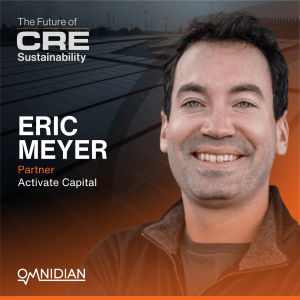
The convergence of AI load growth and distributed generation is creating a once-in-a-generation opportunity for commercial real estate owners. Eric Meyer, Partner at Activate Capital, reflects on how, after a decade of utilities fighting distributed solar, 4% annual demand growth is forcing an "all solutions on deck" mentality that changes the competitive landscape.
Eric outlines Activate's unique approach to climate investing for Sean: rather than betting on early-stage technologies, they target growth-stage businesses with proven product-market fit and real revenue streams. Their portfolio construction strategy around distributed energy assets provides a blueprint for understanding how the energy transition will actually unfold at scale.
Topics discussed:
AI-driven load growth is ending the utility "death spiral" narrative and creating collaborative opportunities between utilities and distributed generation developers.
A growth-stage investment approach targeting businesses with real product-market fit rather than early-stage climate technologies, requiring billion-dollar exit potential.
The portfolio construction strategy around distributed energy assets, spanning financing, flexibility, power electronics, and asset management to capture the full value chain.
Why battery storage adoption in commercial applications significantly lags residential deployment despite similar economic fundamentals and potential solutions.
How interconnection queue bottlenecks favor solar and wind over natural gas generation, creating 2-year versus 5-year development timelines.
Why Omnidian represents a unique "snowflake" position in distributed asset management, providing IoT-enabled monitoring and maintenance that traditional approaches cannot match economically.
How public equity markets are currently mispricing climate risk and opportunity, with infrastructure equipment providers trading at 10x book value while renewable energy platforms trade near book value.
The emergence of distributed capacity procurement programs where utilities rate-base billions in distributed infrastructure to bypass traditional siting constraints.
Why firming intermittent renewable resources through battery storage represents the next phase of grid evolution beyond pure generation deployment.

Thursday Jul 03, 2025
Thursday Jul 03, 2025
The AI boom has triggered the most dramatic transformation in data center history, but it's also created an epidemic of “fake” projects that threaten to undermine the entire sector. Daniel Golding, Chief Technology Officer, Appleby Strategy Group, has coined the term "fake data center" to describe the 90% of proposed AI infrastructure projects that exist only on paper. In his conversation with Sean, Dan reflects on how AI workloads have shattered 25 years of predictable data center development, with single racks now consuming 120 kilowatts — equivalent to powering 30 houses — compared to 10 kilowatts for traditional cloud computing.
This extreme power density has forced operators to abandon air cooling systems entirely in favor of liquid coolants, while project costs have skyrocketed to $5 billion for a single AI-capable building, eliminating speculative development and requiring 100% pre-leasing before ground breaking. Dan also touches on why fiber connectivity often determines project success more than power availability, and why small modular nuclear reactors represent the only sustainable solution for AI's massive energy requirements that only hyperscalers like Google, Meta, and Microsoft have the capital to fund.
Topics discussed:
The “fake” data center epidemic where 90% of proposed AI infrastructure projects lack actual land control, power allocation, or network connectivity despite seeking significant media attention.
How AI workloads have increased power density from 10 to 120 kilowatts per rack, forcing the abandonment of air cooling systems in favor of liquid coolant solutions.
The network effect phenomenon in data center land valuation, where proximity to existing facilities and internet exchange points creates exponential rather than linear value increases.
Why the donut model of internet interconnection eliminated traditional hierarchical ISP structures and enabled massive dark fiber deployments between data center campuses.
The elimination of speculative development in AI data centers due to billion-dollar price tags that hobble elasticity.
Why network connectivity represents the most overlooked aspect of site selection, with fiber infrastructure often determining project viability more than power availability.
Small modular nuclear reactors as the essential long-term solution for AI's energy requirements, with hyperscalers positioned as the only entities capable of funding initial deployment.
Thursday Jun 12, 2025
Thursday Jun 12, 2025
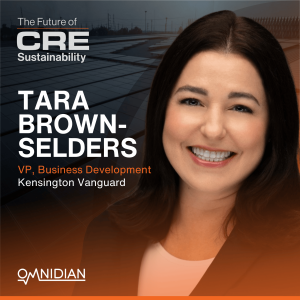
The renewable energy boom is creating unprecedented complexity in commercial real estate transactions, and traditional title insurance approaches are proving inadequate for solar and wind developments. Tara Brown-Selders, VP of Business Development, Kensington Vanguard, has spent three years building KV's energy division by recognizing that these projects require fundamentally different risk assessment, research depth, and regulatory navigation than conventional commercial deals. Her unique background as an ecopreneur turned title insurance specialist provides insights into how property rights, state regulations, and due diligence processes are evolving to support America's energy transition.
Tara explains why renewable projects are more land-intensive with additional parties and longer timelines, requiring specialized understanding of mineral rights versus surface rights ownership. She also touches on the critical timing decisions developers face when engaging title companies, the research complexity that extends far beyond traditional ownership verification, and why some multi-million dollar projects require comprehensive title work without needing insurance policies.
Topics discussed:
The evolution from reactive insurance models to proactive risk assessment strategies that identify issues before they become deal-breakers in renewable energy projects.
Advanced approaches to mineral rights research and surface rights verification that can significantly impact project costs and timelines.
State-by-state regulatory navigation strategies using specialized regional expertise rather than attempting uniform national approaches.
The strategic timing of title company engagement to avoid wasting resources on unviable land while preventing late-stage discovery of deal-breaking property issues.
How ESG integration is reshaping due diligence processes by incorporating stakeholder alignment, community workforce development, and domestic content requirements into commercial real estate decisions.
The emergence of flexible renewable energy solutions like battery storage and micro-grid developments that require smaller land footprints but more complex integration planning.
Why some renewable energy projects require comprehensive title research without insurance policies while others demand full coverage, based on lender requirements and financing structures.
Women leadership strategies in traditionally male-dominated industries through organizations like Women in Title and EcoWomen that emphasize collaboration over competition.
The research complexity of renewable energy projects that extends beyond ownership verification to include mineral activity assessment, community readiness evaluation, and environmental impact analysis.

Thursday Jun 05, 2025
Thursday Jun 05, 2025
The difference between managing solar assets and truly optimizing them often comes down to one critical factor: whether your monitoring system can separate addressable losses from inherent system design limitations in real-time. Alex Snedeker, General Manager of Wattch, has spent years watching O&M teams struggle with legacy monitoring platforms that generate more noise than actionable insights. The result is a dangerous cycle where asset owners think they're managing performance while millions in value slip through undetected gaps in their monitoring infrastructure.
Alex takes Sean through how digital twin technology fundamentally changes this dynamic by using mathematical modeling rather than AI to deliver deterministic outputs with 1-2% margin of error. Unlike linear monitoring models that work reasonably well for homogeneous ground-mount installations, commercial rooftop sites with multiple orientations, string lengths, and inverter capacities require comprehensive system modeling that accounts for every variable. The complexity multiplies exponentially with each addition of heterogeneity, making traditional monitoring approaches increasingly inadequate for CRE applications.
Topics discussed:
The fundamental limitations of linear monitoring models versus digital twin architecture for heterogeneous commercial rooftop installations with multiple orientations and system configurations.
How EPI methodology separates addressable system losses from weather-related variances and design-inherent limitations using real-time meteorological data integration.
The critical importance of commissioning-phase monitoring to identify installation mistakes before final contractor payment, when corrective action becomes economically unviable.
Mathematical versus AI-based approaches to solar performance modeling, emphasizing deterministic outputs that deliver 1-2% margin of error through physics-based calculations.
Portfolio management strategies that prioritize corrective action based on financial impact rather than kilowatt hour losses, enabling resource allocation optimization across multiple assets.
The evolution from reactive O&M practices to exception-based management systems that eliminate alert noise while maintaining high confidence in actionable insights.
Integration of PPA rate data with performance monitoring to calculate precise ROI for corrective actions, enabling data-driven decisions about which issues warrant intervention.
How comprehensive digital twin inputs including electrical layouts, real-time irradiance and temperature data, and third-party component performance data enable string-level and inverter-level diagnostic capabilities.
The workforce constraint challenges facing O&M teams managing accelerating deployment schedules, and how better monitoring tools can multiply team effectiveness without proportional headcount increases.
Thursday May 29, 2025
Thursday May 29, 2025
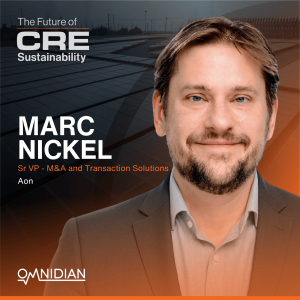
The commercial solar landscape has fundamentally transformed since the Inflation Reduction Act unlocked $800 billion in private investment, but most developers are stumbling over basic tax compliance while missing massive opportunities. Marc Nickel, Sr. VP of M&A and Transaction Solutions at Aon, brings a unique perspective as both a former tax attorney and current insurance broker, having witnessed how tax credit transferability has democratized solar development and created entirely new risk management requirements. His insights highlight why documentation quality matters more than technical performance, and how smart developers are using tax insurance to unlock previously uneconomical markets.
The IRA has bent cost curves so dramatically that solar now makes sense in states like Oklahoma where cheap natural gas previously made renewable energy unviable. The ability to stack investment tax credits up to 70% through energy community designations, domestic content adders, and low-to-moderate income qualifications has opened markets that sophisticated developers are now racing to capture. But success requires understanding the three critical risk buckets: structural risk in your monetization strategy, qualification risk around equipment and compliance requirements, and recapture risk that's statistically far less dangerous than most developers assume.
Topics discussed:
How the Inflation Reduction Act's $800 billion private investment surge created 300,000 new jobs while fundamentally reshaping commercial solar economics across previously unviable markets.
The three-bucket risk framework for solar tax insurance: structural risk in monetization strategies, qualification risk around compliance and equipment specifications, and recapture risk management.
Why cost segregation studies and proper appraisals represent make-or-break documentation that determines whether $50 million projects qualify for their full investment tax credit value.
How tax credit transferability transformed complex partnership structures into simple transfer agreements, democratizing access for small-scale developers previously shut out of the market.
The evolution of tax equity investor requirements from selective 40% coverage to full wrap insurance at 125% of ITC value, including penalties, interest, and contest cost protection.
Strategic timing for tax insurance consideration based on when monetization strategies become clear rather than waiting until project completion or commissioning.
Documentation best practices for IRS audit preparation, including maintaining clean audit trails from EPC contractors and ensuring third-party record accessibility.
How bonus adders including energy community designations, domestic content requirements, and low-to-moderate income qualifications enable 70% investment tax credits that make solar viable in traditionally uneconomical regions.
Common prevailing wage and apprenticeship compliance mistakes that can trigger IRS disputes, plus available cure payment mechanisms to restore full credit value.
Portfolio insurance strategies for developers with multiple projects, including designing standardized project parameters to achieve economies of scale while managing underwriting complexity.

Thursday May 22, 2025
Thursday May 22, 2025
The solar industry stands at a critical inflection point as millions of panels from the early installation boom approach end-of-life. Jesse Simons, Co-founder & CCO of SOLARCYCLE, explains why recycling rather than landfilling is quickly becoming both the ethical and economical choice. Having already processed over a million panels and with plans to scale to 10 million annually, SOLARCYCLE is pioneering closed-loop manufacturing that recovers 95% of materials from used panels and transforms them into new solar components.
Jesse shares with Sean how commercial real estate owners are at the forefront of the repowering movement, discovering that upgrading 10- to 15-year-old systems can double power density from the same rooftop footprint. With major investors like Microsoft, Fifth Wall, and Prologis backing their vision, SOLARCYCLE is demonstrating that the circular economy isn't just environmentally responsible — it's becoming financially compelling as landfilling costs rise and recycling technology improves.
Topics discussed:
How commercial real estate is leading solar repowering, with companies like Target and IKEA already replacing 12- to 15-year-old systems not because they've failed, but because technology improvements enable twice the power density from the same footprint.
The economics of solar recycling versus landfilling, with hazardous waste landfilling costs reaching $18-20 per panel while recycling costs continue to decrease through technological innovation and scale.
SOLARCYCLE's differentiated recycling process that requires three distinct technological approaches for monofacial, bifacial, and thin-film panels, enabling 95% material recovery.
The transition from selling recovered raw materials back to creating closed-loop manufacturing, with plans to convert recycled solar glass into new glass sheets for domestic panel production.
Strategic "pre-cycling" approaches where developers incorporate end-of-life recycling costs into initial PPA pricing, addressing the unrealistic assumptions in many early decommissioning plans.
How corporate sustainability requirements are evolving, with Microsoft and other large buyers now requiring developers to demonstrate circularity plans for all new renewable energy installations.
Growth projections indicating 40-50 million panels will reach end-of-life annually by 2030 in the U.S. alone, creating both environmental challenges and economic opportunities.
Partial repowering strategies where commercial building owners retain racking systems while upgrading only panels, maximizing investment returns while maintaining sustainable practices.
Thursday May 15, 2025
Thursday May 15, 2025
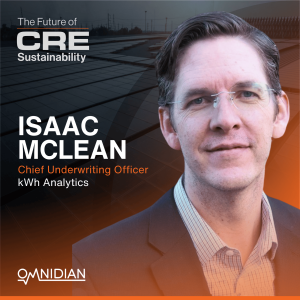
Commercial real estate owners are discovering that insurance for renewable energy isn't just a necessary evil — it's becoming a strategic tool for optimizing performance and unlocking additional ROI. In his conversation with Isaac McLean, Chief Underwriting Officer at kWh Analytics, Sean explores how data-driven insurance is transforming asset management for solar and battery installations. Isaac shares a striking example of how one client cut their deductible in half simply by implementing proper hail stow protocols, creating immediate financial benefit from operational improvements.
Recorded at Asset Management North America in San Diego, this episode dives into the evolving landscape of risk management for commercial properties with renewable energy assets. Isaac highlights the surprising ways battery storage is moving beyond backup power to become revenue-generating opportunities during peak demand hours, while simultaneously qualifying for valuable tax incentives through the Inflation Reduction Act.
Topics discussed:
How insurance carriers are transforming from passive risk absorbers to active partners in asset performance through data-informed incentives that reward resilient design choices and proactive maintenance.
The strategic opportunity for commercial property owners to monetize battery storage systems by charging during off-peak hours and selling back to the grid during evening demand spikes, creating dual revenue streams alongside tax benefits.
Why emergency response planning remains dangerously overlooked, evidenced by real cases where firefighters delayed addressing solar fires due to uncertainty about electrocution risks during water application.
How hardware selection criteria differs between insurance underwriters and asset owners, with insurers preferring tried-and-tested panels with thicker glass against impact versus lighter, cheaper alternatives with thinner materials.
The emergence of specialized insurance tools like KWH Analytics' hail risk assessment form that systematically evaluates weather protocols and stow procedures to quantify resilience and adjust policy terms accordingly.
The evolving methodology for differentiating risk profiles between installation types (rooftop, carport, ground-mount), with specific underwriting considerations for permanence of mounting systems, elevation factors, and protection against vehicle strikes.
Why vegetation management, debris clearance, and connector inspections rank among the highest-impact maintenance practices for reducing premiums and preventing thermal events (fires), which represent the second largest loss category after natural catastrophes.
Strategic approaches to spare parts inventory planning that balance immediate risk reduction with long-term flexibility for aging assets, including considerations for secondary markets and engineering resiliency plans.
How thermal runaway risks in battery storage systems require specialized monitoring protocols and emergency response planning that differs substantially from traditional solar-only installations.
Future predictions for commercial real estate sustainability, including longer-lasting roofing materials protected by overhead solar panels, widespread integration of charging infrastructure, and increasing utilization of IRA tax credit transferability options.
Thursday May 08, 2025
Thursday May 08, 2025
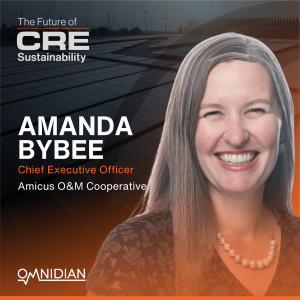
The solar industry's workforce challenges run deeper than just hiring more technicians: we need a complete transformation in how we train, certify, and retain talent. Amanda Bybee, Chief Executive Officer of Amicus O&M Cooperative, joins Sean on this episode of The Future of CRE Sustainability to share the industry's first ANSI standard for solar and battery storage technicians. This framework introduces a four-level professional development pathway that could resolve chronic labor challenges while ensuring systems perform optimally for decades.
Amanda shares why commercial real estate owners should view O&M not as an optional expense but as essential performance insurance, warns against confusing workmanship warranties with proper maintenance, and makes a compelling case for a more circular approach to solar equipment at end-of-life. Throughout the conversation, she emphasizes that despite constant market volatility and policy shifts, proper technician training cannot be sidelined — it's foundational to the industry's future and directly impacts the ROI of every installed system.
Topics discussed:
The development and implementation of the industry's first ANSI-approved standard for solar and battery O&M technicians, creating a four-level professional framework that defines required knowledge, training objectives, and measurable competencies.
How standardized training pathways address the chronic solar labor shortage by creating clear career advancement opportunities rather than letting technicians bounce between companies seeking higher pay without validated skills.
Implementation strategies for organizations adopting standardized training, including starting with pilot programs, reassuring technicians about pay stability, and having senior techs engage with training materials from an instructor perspective.
The critical distinction between workmanship warranties (which cover installation defects) and O&M agreements (which provide proactive performance monitoring and preventative maintenance) — a confusion that leads many system owners to under budget for proper care.
The three-pillar business case for proper O&M: safety for people around the installation, performance optimization of the financial investment, and warranty preservation requiring documented maintenance.
Balancing urgent market challenges (e.g, tariffs, policy changes, supply chain disruptions) with the essential need for technician training, avoiding the trap of sidelining training because the consequences aren't immediately visible.
The industry's emerging approach to circularity, challenging the current paradigm by advocating for testing and reusing functional modules from decommissioned systems before recycling, creating a secondary market for replacement parts.
The financial reality of proper solar asset recycling, including the need to budget for end-of-life costs in initial financial projections and the importance of driving down recycling costs to prevent improper disposal.
How quality assurance during construction significantly reduces long-term O&M issues, particularly focusing on connection quality, wire management, and establishing golden row standards at project start.